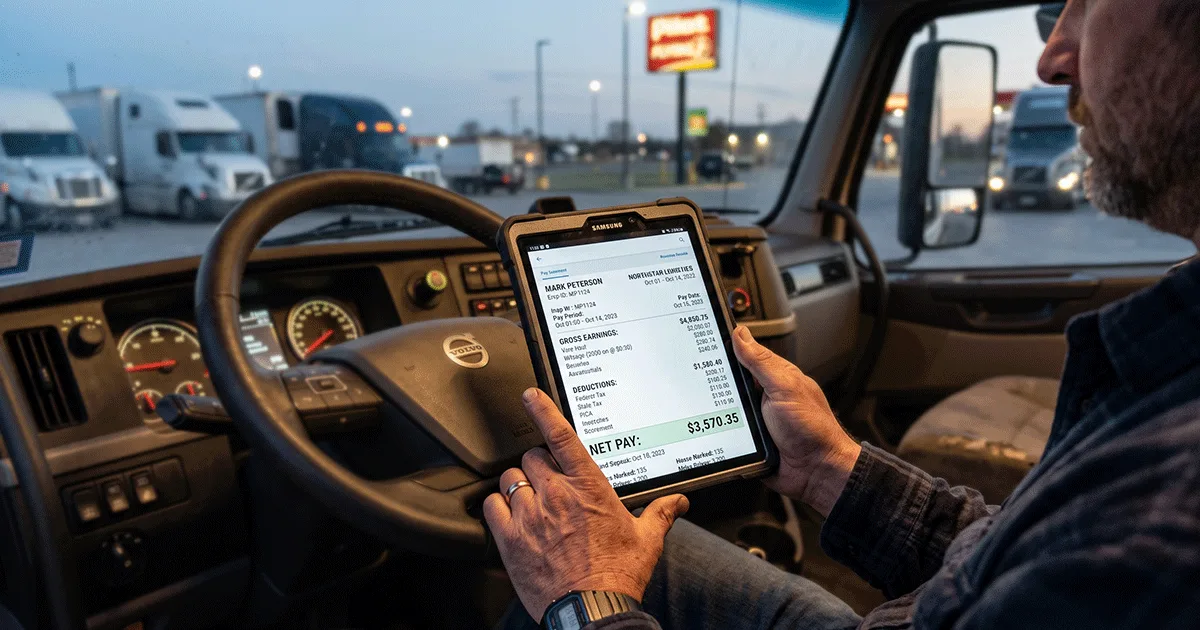
In 2026, company truck drivers make an average of $0.50 to $0.75 per mile, while owner-operators gross between $1.80 and $3.00+ per mile. However, your true take-home pay depends heavily on your loaded miles, unpaid deadhead miles, and accessorial pays.
If there is one question I get asked constantly by new drivers entering the industry, it is: "How much do truck drivers make per mile?" Early in my career, I used to think the highest CPM offer was automatically the best job. I learned the hard way that a high CPM with low weekly miles or massive unpaid wait times results in a tiny paycheck. Over the years, I have analyzed countless pay structures, transitioning from a company driver making modest base pay to an owner-operator analyzing every single cent of revenue against operating expenses. Understanding how to properly dissect your pay per mile will save you from taking unprofitable loads and help you maximize your income on the road.
Table of Contents
What Is the Average Pay Per Mile for Truck Drivers in 2026?
The average pay per mile fluctuates heavily based on whether you are a company driver or an owner-operator, as well as the type of freight you haul. Company drivers typically see rates between $0.50 and $0.75 per mile, while owner-operators gross significantly more to cover their immense overhead costs.
When I look at the current market, I see a vast spectrum of pay rates. The base rate you receive is heavily dependent on your employment status and the trailer attached to your rig.
Company Drivers vs. Owner-Operators
As a company driver, I did not have to worry about fuel, maintenance, or truck insurance. My CPM was pure income (before taxes). Currently, experienced company drivers can expect anywhere from $0.60 to $0.75 per mile. When I transitioned to becoming an owner-operator, my gross CPM jumped to between $2.00 and $3.00+ per mile. However, that entire increase went straight into covering fuel, IFTA taxes, and unexpected breakdowns.
Flatbed vs. Dry Van vs. Reefer Rates
The type of freight you haul dictates your earning potential. I spent years pulling a dry van because it was the easiest freight to handle, but it also paid the lowest. When I switched to pulling a refrigerated trailer (reefer) and occasionally a flatbed, my CPM increased because of the extra labor and liability involved in securing and monitoring the load.
| Trailer Type | Company Driver Avg. CPM | Owner-Operator Avg. Gross CPM | Effort & Liability Level |
|---|---|---|---|
| Dry Van | $0.50 - $0.65 | $1.80 - $2.20 | Low (Drop & Hook) |
| Reefer | $0.55 - $0.70 | $2.10 - $2.50 | Medium (Temp Control) |
| Flatbed | $0.60 - $0.75+ | $2.30 - $3.00+ | High (Tarping/Securing) |
How Can I Calculate My CPM Earnings Accurately?
Accurately calculating your earnings requires tracking both your loaded and empty miles, applying your specific CPM rate, and utilizing a reliable calculator to predict your weekly or monthly take-home pay before you even start the engine.
I never start a trip without doing the math first. Early on, I would just multiply my dispatch miles by my CPM and assume that was my paycheck. I was always disappointed on payday.
Factoring in Deadhead and Unpaid Miles
"Deadheading" means driving with an empty trailer. If a dispatcher offers me a load that pays $0.70 a mile for 1,000 miles, that sounds like a $700 run. But if I have to drive 200 miles empty just to pick up that load and I am not getting paid for those empty miles, I am actually driving 1,200 miles for $700. That drops my real, effective CPM down to $0.58 per mile. This is the hidden trap I see many new drivers fall into.
The Best Way to Use a CPM Earnings Calculator
Instead of doing napkin math, I plug my trip details into a CPM earnings calculator. I input my loaded miles, my empty miles, and my base rate. It gives me a realistic projection of what my check will actually look like, allowing me to negotiate better rates or decline unprofitable runs altogether.
What Factors Influence How Much Truck Drivers Make Per Mile?
Your CPM is never static; it scales upward with your years of safe driving experience, the acquisition of specialized endorsements like Hazmat, and your willingness to drive in difficult geographic regions like the Northeast.
I didn't start out making top dollar. My CPM grew as my resume grew. Carriers pay for reliability and skill.
CDL Experience and Specialized Endorsements
During my first year, my CPM was rock bottom. Companies view new drivers as high-risk. But after 2 years of clean driving, I negotiated a massive CPM raise. To boost my income further, I invested a few hours into getting my Hazmat and Tanker endorsements. Even when I wasn't hauling hazardous materials, having the endorsement made me a more valuable asset to the dispatchers, bumping my base rate up by a few cents per mile across the board.
Geographic Region and Freight Lanes
Where you drive matters just as much as what you drive. I used to run a dedicated lane through the Midwest. The roads were flat, parking was easy, and the speeds were fast, but the CPM was average. When I decided to run freight into the Northeast, my CPM skyrocketed because carriers have to pay a premium to convince drivers to deal with NYC traffic and tight docks on the East Coast.
How Do Accessorial Pays Add to My Final Paycheck?
Base CPM is only part of the story. Accessorial pays compensate drivers for their time spent performing non-driving tasks, ensuring you are still earning money while sitting at docks or taking mandatory downtime due to scheduling failures.
My CPM only pays me when the wheels are turning. But what happens when I am stuck at a shipper for 6 hours? That is where accessorial pay saves my paycheck.
Detention Pay
Detention pay is critical. Standard practice is that the first two hours at a dock are unpaid. After that, I demand detention pay (usually around $20 to $50 per hour). I once sat at a grocery warehouse for 8 hours waiting to get unloaded. Without detention pay, I would have lost an entire day's worth of income while burning up my 14-hour clock.
Layover and Stop Pay
If a receiver rejects a load or pushes my appointment back by 24 hours, I charge layover pay for the lost day. Additionally, if I am hauling a load with multiple drop-offs, I ensure I receive "stop pay" for every extra delivery location after the first one, compensating me for the time spent navigating to multiple docks.
What Are the Real Expenses Deducted from Gross CPM?
For owner-operators, a high gross CPM is deceptive; you must subtract astronomical fuel costs, quarterly IFTA taxes, monthly insurance premiums, and a heavy maintenance reserve to reveal your actual net profit per mile.
When I got my own authority, I thought I was rich seeing $2.50 per mile on the load board. I quickly realized how fast that money vanishes before it ever reaches my personal bank account.
Fuel Costs and IFTA
Fuel is my absolute largest expense. If diesel is $4.00 a gallon and my truck gets 7 miles to the gallon, I am spending over $0.57 per mile just to keep the truck moving. On top of that, I have to calculate and pay quarterly fuel taxes using an IFTA calculator. Managing fuel economy is the difference between turning a profit and going bankrupt.
Maintenance and Insurance
I never run a mile without putting at least $0.15 to $0.20 per mile into a dedicated maintenance savings account. Tires blow, injectors fail, and preventive maintenance is non-negotiable. Add commercial trucking insurance, which can run over $15,000 a year, and that shiny $2.50 CPM quickly shrinks down to a humble net profit.